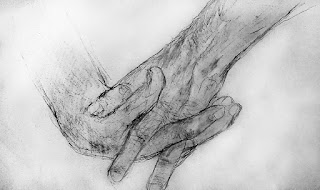
Hush

The kitchen was neither too big nor too small. It was rather longish. It breathed in quiet warmth. Steam curled from a pot and cumin crackled in oil. She reached for the salt; he was already holding it out. Their fingers brushed—brief, unspoken, familiar. Outside, a cuckoo was calling in desperate bursts of ecstasy. Winter lingered in the air, in stray gusts of cool wind. Children were playing in the park, their bright laughter rising and falling with the wind. Water dripped from the tap into the sink at regular intervals, forming a rhythm. They noticed it, yet let it be.

Taste this, a little more, perfect. 

He stirred while she leaned against the wall, watching with a half-smile that he caught in the reflection of a steel lid. Chopping, stirring, and passing bowls. Now and then, sunlight glinted off the utensils as they moved from place to place. Now she nodded. Then she lifted one eyebrow, the way he did when something quietly amused him. A playful nudge of the elbow. Then, as he wrapped his arms around her from behind, she smiled, lightly admonished him, and melted into his embrace. The light in the kitchen bounced off plates, dishes, saucers, and vegetables. Nascent spring flowed like a quiet current between them, simmering. They were cooking aloo-jhinge-posto.

From downstairs, a kabadiwala’s called— sheeshee botol kago-o-o-o-j. The streets of Kolkata felt timeless, especially in this northern quarter of the city, where the soundscape was a mélange of hawkers’ languid cries, the unhurried footsteps of pedestrians, chatter spilling from roadside tea stalls, bells from a nearby Kali temple, the distant azaan from a mosque, the clinking bells of hand-drawn rickshaws, sounds of bandar-nach, and, of course, the restless traffic—trams, motor vehicles, buses, and the occasional burst of choicest expletives. But a Sunday afternoon like this, when the city fell into a softer hush and the contours of the quiet were traced by the lonely call of a cuckoo singing for its mate, the world seemed suspended in time. It could be the 21st century or the 20th or the 19th. 

Taking a break from the kitchen, and lying on their back in bed, they gazed up at the kadi-barga ceiling. In traditional kadi-barga construction, long wooden or steel beams called kadi supported smaller crosspieces known as barga, above which layers of tiles, lime, surki, and khoya formed the roof, while the structural load of the floors and roof was borne by the walls and transferred sequentially through the walls to the foundation and then to the ground, allowing two or three storeys to be built above the kadi-barga roof. 

They lay quietly, watching the flickering shapes and colours of passing vehicles below filter through the louvred khorkhori janalas and ripple across the ceiling like fleeting shadows. No other soul lived in this old four-storey house. No other soul lived in this old four-story house. 

That morning, he had gone to the bazaar to buy a fresh katla, and returned with a few sunflowers as well, which he arranged in porcelain vases, though it was not quite the season for them. She had given precise instructions about the size and quality of the fish. She planned to make aam-katla and had asked him to bring raw mangoes as well. She had not been able to get the dish out of her mind since tasting it at a friend’s house a few weeks ago. After managing to get the recipe, she decided to make it today. 

As she got up to go back to the kitchen, he reached for her hand and drew her back onto the bed, trying to steal a kiss on her cheek. She grew coy, even after all these months, and managed, smiling, to wriggle out of his grasp. He lay there basking in the soft half-sunlight filtering through the curtains—and in the lingering half-smile that she left behind as she trailed toward the kitchen to begin making aam-katla.

He dozed off for a while, the sort of brief, timeless, deep sleep that comes when the mind has settled into a rare and peaceful stillness. A butterfly entered the room unbeknownst to anyone and perched on the top of the window to the balcony. He took his glasses which had been resting on his chest while he was dozing and put them on— it’s was only a moth. 

Stepping out onto the balcony, he lit a cigarette and begam idly studying the building opposite—the grey walls, the shuttered windows, clothes sagging slack and stirring on a washing line across the terrace, jars of achaar ranged along the parapet, and a black kite snagged in the antenna. A yellow cat appeared on the veranda across the way, touched the wrought-iron railing with its nose, and slipped back inside and disappeared. 

She had slipped in from the kitchen, silent as a cat, and he was startled to feel her arms suddenly close around his waist. The quiet of the afternoon had settled him into a gentle trance of stillness. She came around in front of him and, holding his left hand with her right, made a small gesture, bringing her thumb and index finger close together—it was a quiet sign of asking if he would like some tea. They had numerous such signs. He nodded, smiling, and repeated the little gesture. She disappeared into the kitchen to make the tea. She liked hers light, with only a little milk; he preferred his thick with it. Yet it was not the tea he cherished so much as her asking him whether he wanted some—the quiet anticipation, somehow richer than the tea itself. He stubbed out his cigarette.

The aam-katla was a disaster. She had added far more raw mango than the curry for two could possibly endure. Realizing the mistake almost at once, she tried to rescue it—first with water, then with a hopeful spoonful of sugar, as though diplomacy might still be possible. 

After finishing the aloo-jhinge-posto, he took an eager mouthful of the fateful aam-katla with rice. The moment it touched his tongue, it exploded in his mouth—sharp, and seemingly determined to escape the way it had entered. He froze for a moment, but bravely pretended that everything was perfectly fine. For a few seconds he nodded thoughtfully. But the effort proved too heroic to sustain. In the end he surrendered. Neither of them could finish the dish, and they had to fall back on extra helpings of aloo-jhinge-posto and musoor daal with rice to fill their stomachs. They laughed about it, and the mishap would return again and again whenever aam-katla was mentioned in the years to come. 

Post-lunch, lying in bed, folded into each other’s arms, they felt a slow heat gathering between them. The kind of heat that belongs to long afternoons and half-lit rooms. Like magma flowing under the ground and looking for an opening, he thought. With a bold, lingering gesture of almost an entitlement, he drew the edge of her saree down just below her navel. In the softened light he watched the quiet perfection of its curve, the small til resting a few millimetres away like a secret and sacred punctuation. His finger moved around it in a slow circle, and her breath rose, her breasts lifting, her stomach drawing inward for a moment into a tender hollow. Then they kissed. Her mouth smelled of paan. When their tongues met, the room seemed to loosen its hold on them. 

They drifted into a strange, wordless landscape of warmth—through deserts of heated air, along rivers that seemed to flow beneath the skin, across mountains and oceans of shifting temperatures. Their bodies wandered through terrains of different soils and textures: sometimes damp grasslands after rain, sometimes vast dry stretches of sand. Sounds seemed to come from somewhere deep beneath the earth, low and ancient. The world of sight faded, growing dim and distant, while sensation sharpened and spread. In those suspended instants they felt both more than alive and almost beyond life itself—moments hanging weightless in time, or rushing past with the speed of light. From a deep chasm a fountain suddenly surged forth, and in that single instant they seemed to witness the entire life of a river—its birth in that trembling spring, its quickening flow through valleys and plains, and at last its inevitable, longing union with the sea. 

They lay asleep merged pell-mell into each other, limbs and breath mingled indistinguishably. The sudden bang of a window shutter startled them apart. A storm had risen outside. In the distance the tall coconut trees swayed wildly, helpless and almost comical in the wind. She hurried out to the veranda to gather the clothes from the clothes line and then climbed to the terrace for the ones left there to dry. As she hastily bundled the clothes into her arms, the rain began—first a few large, heavy drops, darkening the concrete one by one. 

When she stepped back indoors, her feet were drenched, leaving dark, fleeting footprints across the red-oxide floor. One by one they faded, vanishing almost instantly in the cool gusts sweeping through the room, the curtains whipping and thrashing wildly in the wind. She shot him a look—sharp, wordless, and somewhat reproachful—as if to say he should have already rushed out to pull the clothes off the clothes lines and shut the windows before the storm broke. But he had been too lazy to move. 

He saw that she was disappointed. He tried to make amends by reaching for her, drawing her into his arms. She pushed him away at once. Yet almost the very moment she did, a violent crack of thunder exploded somewhere nearby. Startled, she rushed straight back and clung to him. The sound of thunder had always terrified her. Tiny beads of rain glistened across her forehead, catching what little light remained. Slowly she lifted her eyes to his. The room had dimmed so much that the edges of things had begun to dissolve; he seemed almost veiled, as though a thin drift of smoke had gathered between them. His lips were slightly parted, poised on the brink of words that had not yet taken shape. 

Everything else had again fallen utterly still. The silence was so deep she felt she might hear the quiet thud of his heart in the hush between them. She certainly heard her own—quick and insistent. 

Those evenings… 
When startled, I whispered your name; 
When my heart, 
Wandered restless in longing and flame— 
When I spoke to the shadow beside my feet; 
Waiting for someone who might yet appear 
Out of the dusk, soft-footed and near. 
Those moments, bare and long— 
Empty of music, bereft of song— 
Those moments… tell me then— 
Did they carry no meaning within? 

Nothing is wasted. 
Nothing is vain. 

The rain had passed. A loadshedding swallowed the house in shadow, yet no one moved to strike a match or light a candle. It felt as though the darkness itself was something fragile, something neither of them wished to disturb. 

Outside, from somewhere far away came the long, tremulous sound of a shaankh

Now they stood side by side before the mirror. Neither spoke. The glass held them both in its quietude, and behind their reflections countless others seemed to follow, receding endlessly into shadow, as though time itself had arranged a procession of their past selves. 

They did not appear as they were now. Instead, the mirror returned them to another day entirely. He stood there in an off-white panjabi and dhoti, the topor poised on his head; beside him she wore her red Benarasi sari, rich and luminous even in the fading light. This was their wedding day. They were now at the threshold of a life that was before them. That moment had never quite passed. 

She fastened the wristwatch around his wrist carefully. In the dark, the clasp clicked into place with a soft, final, metal sound. He reached out and straightened the folds of her sari, smoothing the pleats. There was a hush. Only the tinkling of her sankha-pola and the tiny bells of her nupur broke the stillness. And beneath that clinking another sound—her quiet sobbing. 

The next day a bulldozer arrived and tore into the building, grinding plaster, brick, and timber into a collapse. Standing nearby, the contractor gave brisk instructions to the construction workers: if anything of value turned up in the rubble, it was to be set aside. 

Now and then a worker would stoop, brush away dust, and lift out something that looked worth keeping—a brass utensil, a wooden frame still half intact. These they placed in a small, growing pile at the edge of the site. Several objects added to the pile. But an old black-and-white photograph, its glass cracked, of a newly married couple— a bridegroom in a garod panjabi and silk dhoti with his bride in a red Benarasi— wasn’t among them.


Comments

Popular Posts